You’ve invested in a well-designed online store, you’re getting traffic, your product pages are polished… and yet the sales aren’t following. You’re not alone. The reality of e-commerce is that the vast majority of your visitors leave empty-handed — and often for reasons you can fix. Here’s why it happens, and more importantly, how to change it.
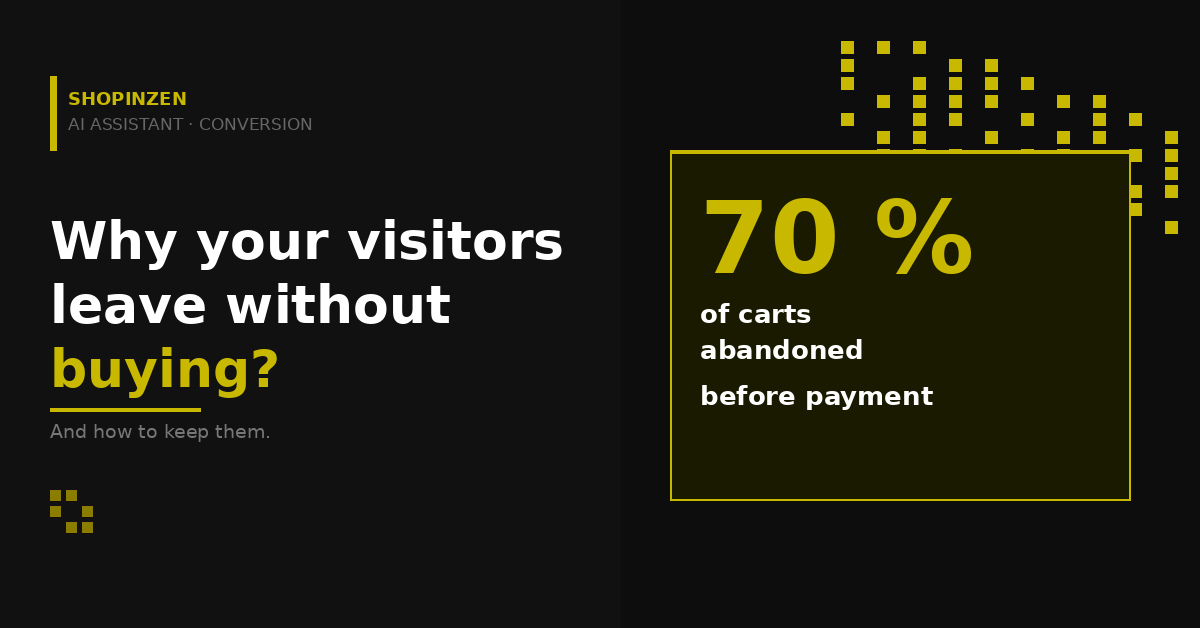
The number that hurts: more than 70% of your visitors never complete a purchase
This isn’t an exaggeration. The average cart abandonment rate in e-commerce exceeds 70% — and climbs to 80% on mobile. In other words, out of 10 visitors who add a product to their cart, only 3 actually complete their purchase. The other 7 simply disappear.
And before visitors even reach the cart, another portion leaves without exploring your store at all: the average bounce rate for an e-commerce site sits between 30% and 50%. That represents thousands of euros in potential revenue evaporating every month — often without you knowing exactly why.
The good news? These departures are not inevitable. They have precise causes, and concrete solutions exist for each one.
The real reasons your visitors leave without buying
1. They have a question and nobody answers
This is the number one cause of silent abandonments. A visitor hesitates over a size, a compatibility question, a delivery time, a return policy. They’re looking for an answer — and they can’t find one immediately. Rather than digging through your FAQ or sending an email that won’t get a reply for 24 hours, they close the tab and order from a competitor.
That visitor intended to buy. You didn’t lose them because of your product — you lost them because of a gap in the buying experience.
2. Extra fees appear too late
48% of shoppers who abandon their cart cite unexpected costs — shipping, taxes, service fees — as the main reason. The problem isn’t necessarily the amount: it’s the surprise. A visitor who discovers €8 in shipping fees at the checkout stage feels misled. Transparency from the product page onward is essential.
3. You’re asking them to create an account
24% of cart abandonments are linked to being forced to create an account to complete a purchase. This is a significant barrier for a first-time buyer. They don’t want to commit — they want to order quickly. Every extra step is a potential exit door.
4. Your site is too slow — especially on mobile
47% of visitors abandon a site that takes more than two seconds to load. And with 74% of e-commerce transactions happening on mobile in 2024, a poor mobile experience is a permanent drain on potential customers. Technical performance isn’t a detail — it’s a direct conversion factor.
5. The buying journey isn’t reassuring enough
A visitor who doesn’t know your brand needs reassurance: visible customer reviews, a clear return policy, visible secure payment badges. Without these trust signals, doubt creeps in — and doubt leads to abandonment.
6. Nobody is available at the right moment
Customers often decide to buy outside of business hours — in the evening, on weekends. If your customer service is only available Monday to Friday from 9am to 6pm, you’re missing a significant share of your conversion opportunities. 51% of online shoppers are more likely to complete a purchase on a site that offers live chat.
What these lost visitors are actually costing you
Let’s put concrete numbers on the problem. Say your store receives 5,000 visitors per month, with an average order value of €60.
- At a 2% conversion rate (on the low end of average): 100 orders, or €6,000 in revenue
- Bringing your conversion rate up to 3% through a better experience: 150 orders, or €9,000 in revenue
- That’s €3,000 in additional monthly revenue — without spending a single cent more on acquisition
This is exactly where real e-commerce growth happens: not by driving more traffic, but by converting the traffic you already have.
The solution: being present at the right moment, with the right answer
Most abandonments happen because the visitor is left alone with a hesitation, with nobody to guide them at the critical moment. That’s exactly what an intelligent conversational assistant solves.
Concretely, a conversion-focused chatbot like Shopinzen steps in at every critical stage of the buying journey:
- On product pages: instantly answers questions about sizes, delivery times, and product specifications — without the visitor having to look elsewhere
- At the cart stage: proactively re-engages hesitant visitors, offers help, or reminds them of your shipping guarantees
- 24/7: available even at 11pm on a Sunday, when your team isn’t
- Multilingual: so you never lose an international customer over a language barrier
The result? E-commerce merchants using Shopinzen report an average of +35% conversion rate increase and -40% bounce rate reduction. Industry studies back this up: chatbots reduce cart abandonment by 20 to 30% by guiding customers through to purchase completion.
Where to start, practically speaking
Before installing anything, identify where your visitors are dropping off:
- Analyze your exit pages in Google Analytics: which pages see the most departures? Product pages, cart, checkout?
- Check your cart abandonment rate: if it exceeds 70%, you have a clear priority
- Test your mobile load time with PageSpeed Insights — aim for under 2 seconds
- Experience your store as a customer: place an order on your own store from your phone. Where does it feel clunky?
Once you’ve identified the friction points, deploying a conversational assistant on your highest-exit pages is often the fastest action to implement — and the most impactful on conversions.
Conclusion
Your visitors don’t leave because your store is bad. They leave because they had an unanswered question, an unpleasant surprise, or a moment of hesitation that nobody helped them through. Those moments of doubt are recoverable — as long as you’re there when they happen.
A well-configured conversational chatbot is exactly that: a salesperson available around the clock, who knows your products, reassures your customers, and guides them all the way to checkout. No hiring, no extra ad spend.
Shopinzen lets you deploy this assistant in just a few clicks, for free, with zero coding required. Try it on your store at shopinzen.com.
This article is for informational purposes. Statistics cited come from recognized industry sources (Baymard Institute, FEVAD, Dynamic Yield) and are subject to change.